
The FDR Park Plan, the airport, and the effects on Eastwick
The purpose of the manmade wetlands constructed by PHL Airport in the southern part of the Meadows is to greenwash both the FDR Park Plan and the expansion of the airport.
The city-owned airport is paving over wetlands in Tinicum, in the Darby Creek watershed, to expand its capacity to handle cargo. Philadelphia’s lowest-lying neighborhood, Eastwick, is in that same watershed.
Eastwick is already among the neighborhoods most impacted by environmental injustice: landfills/brownfields, poor fill conditions, and chronic flooding. Although they knew that Eastwick is in a floodplain, city planners long ago chose it for the relocation of poor, mostly African-American residents who were being displaced by West and North Philly gentrification.
The city recognizes the problems that Eastwick faces, but the destruction of the wetlands in Tinicum by the city’s airport threatens to worsen the flooding in Eastwick.
Although federal law requires wetland destruction to be “mitigated” by creation of equivalent new wetlands, the airport didn’t put the new wetlands where they would mitigate flooding in Eastwick. Instead, it put them in FDR Park — where there were already were wetlands.
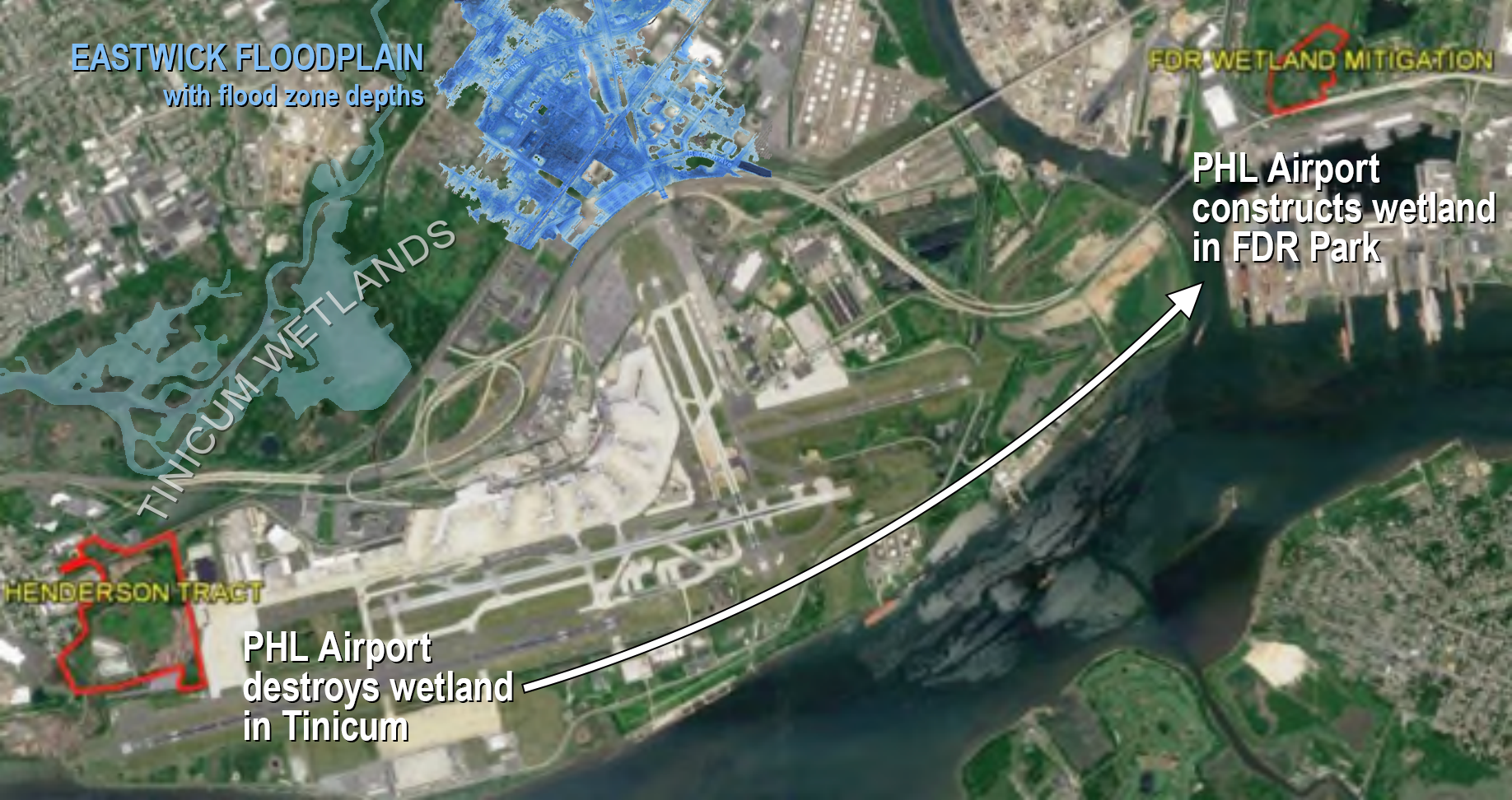
Base map from PIDC Request for Proposals. Flood overlay (blue) from FEMA Eastwick Flood Map.
The city spelled it out in its Request for Proposals for the FDR mitigation:
“The goal of the project is to develop a viable wetlands mitigation area to compensate for impacts of proposed and future development of the Philadelphia International Airport (PHL).”
By using our park to meet this mitigation requirement, Philadelphia Parks & Rec isn’t creating an environmental benefit. It’s enabling the expansion of the city’s airport and increasing flood risk in Eastwick. That’s greenwashing.
Eastwick residents, whose comments on the project's environmental assessment were ignored, should not have to pay the price for the airport’s expansion, continuing a longstanding pattern of exclusionary, racially biased decision-making.
More info: