
Background
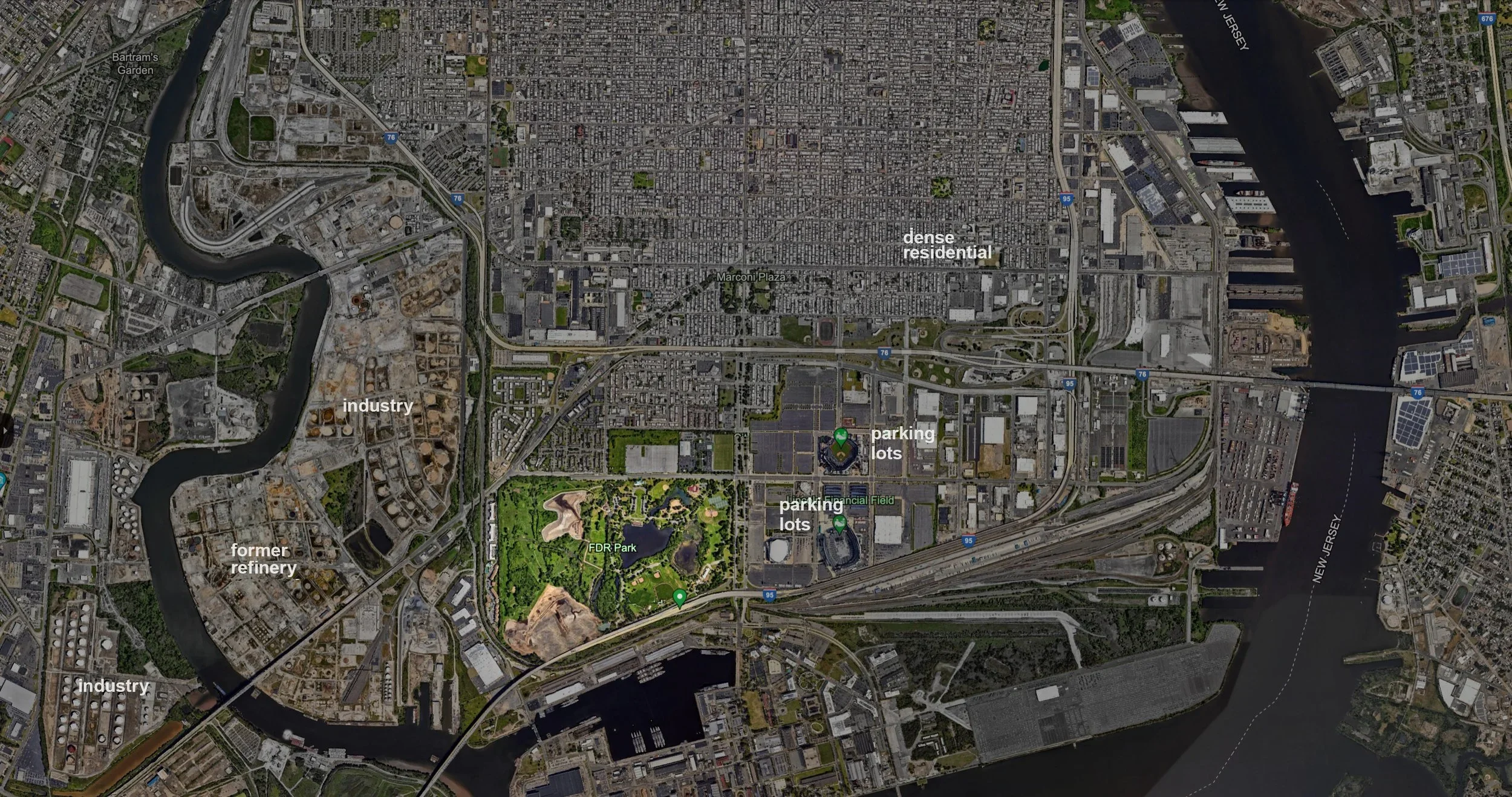
In 2019, the Parks & Rec Department closed the FDR Golf Course after 80 years, citing declining use and frequent flooding. The COVID pandemic stalled development plans, giving the land an opportunity to rest and regrow. As the pandemic drove the community to seek access to outdoor space at unprecedented levels, the Meadows quickly became a beloved local oasis.
The Meadows emerged as a magical space — one of the few re-wilded areas inside the city limits that doesn’t force you to enjoy yourself in prescribed ways, and the only large, unmanicured green public space in South Philly.
Now Philadelphia Parks & Recreation is implementing its controversial FDR Park Master Plan. It would clearcut nearly all of the Meadows, install over 30 acres of toxic artificial turf, along with roads, parking lots, and other facilities, and hand control of the entire park to the private group that created the plan: the Fairmount Park Conservancy.
In August 2022, 70 acres of mature tree canopy and habitat were razed to the ground. And in May and June 2024, almost 20 acres more, including the Picnic Grove and 48 healthy heritage trees.
These maps show what’s been done and what’s planned.
The plan and the opposition is complex and nuanced. Read on for clarity on what's happening in FDR: the details, facts, and rebuttals you deserve to know.
We promise to not keep you in the dark or tell you only half the story. That’s our commitment to you, the land, and to the justice we all deserve.
Frequently asked questions
-
As of summer 2026, Parks and Rec and the Fairmount Park Conservancy have destroyed about 75 acres of the Meadows, out of 175 acres.
But there’s been no major clear-cutting since 2024, when they bulldozed the Picnic Grove and surrounding area. Hundreds of trees, including dozens of irreplaceable heritage trees, were clearcut for the “Pattison Fields” phase of the plan: nine artificial turf athletic fields along with roads and parking lots. Only one of those fields is in progress, now nearing completion.
About 100 acres remain virtually untouched — so yes, there’s plenty left to save!
It’s a thriving habitat for many species, and has been named an important birding area by Audubon. Native plants abound, including two species that are protected under Pa. environmental law, as do endangered monarch butterflies.
It’s home to the most significant tree canopy in South Philadelphia with many thriving heritage trees that are 40-80+ years old that are legally protected. Although this space has played many roles in its history, it’s now one of the last unmanicured green spaces in South Philadelphia.
See also:
Map series showing phases of the project so far, and what is planned
Detailed timeline of the whole project and the opposition to it.
-
Almost all of the 175 acres of Meadows is to be developed. In addition to the 16-field sports complex, 33 acres of artificial wetlands were constructed to offset a wetland-destroying expansion of PHL airport. About 75 acres have already been clearcut. Most of the rest is planned to be clearcut and relandscaped according to the Fairmount Park Conservancy’s vision. The next phase was slated to begin in 2025, but appears to be unfunded — and hasn’t been approved by the Pa. Dept of Environmental Protection (DEP).
Aside from the Meadows, the rest of the park will also be fundamentally changed. There are some very reasonable upgrades in progress: road repair, improved playgrounds, and basic amenities such as restrooms. However others involve privatization of our public spaces, such as the “Welcome Center.” This is a chronic problem in Philadelphia.
-
Let’s just get this out of the way: No.
The city included FDR Park among six sites it offered FIFA for use as World Cup practice fields. Then, along with the Fairmount Park Conservancy, it claimed that the new fields were “under consideration” by FIFA — an apparent bid to build enthusiasm for their project.
But there’s no sign that FIFA ever had any interest in using FDR Park.
That’s not surprising. FIFA requires grass for World Cup play, not artificial turf. In any event, by late 2024 FIFA had chosen a different site. And by the time the World Cup was over, not a single field in FDR Park had been completed.
-
YES, there’s still plenty left to save — more than half of the Meadows, almost 100 acres. Here’s how to visit.
It’s a thriving habitat for many species, and has been named an important birding area by Audubon. Native plants abound, including two species that are protected under Pa. environmental law, as do endangered monarch butterflies.
It’s home to the most significant tree canopy in South Philadelphia with many thriving heritage trees that are 40-80+ years old that are legally protected. Although this space has played many roles in its history, it’s now one of the last unmanicured green spaces in South Philadelphia.
-
Of this massive $250 million project, only the first phase of the Meadows destruction has been funded. Only one of the 16 athletic fields has been funded, and is under construction as of mid-2026.
Meanwhile, the Fairmount Park Conservancy has already spent the $54M that the City pledged and has failed to raise anything close to what is budgeted for future phases. With a funding shortfall and no contracts, they may never be completed.
The Conservancy, the City of Philadelphia, and the city-owned PHL Airport are the main funding sources so far, with some additional funding from foundations such as the William Penn Foundation and from the state.
These funders should spread their investments equitably across existing city facilities in desperate need of maintenance instead of on this single gentrifying development.
-
Phila. Parks & Rec has celebrated the plan as a victory for the environment because it includes construction of 33 acres of wetlands. But that’s pure greenwashing.
Here’s the real motivation:
The city-owned PHL airport wants more cargo business from Amazon and the like, so it is developing a 400-acre expansion. About 40 acres of natural wetlands and waterway in Tinicum is being paved over for it.
The airport is federally mandated to “replace” the wetlands it is destroying, so it paid $30M to create artificial wetlands in FDR Park. Want proof? It’s here.
The wetlands project in FDR does not represent any kind of environmental effort by the city. It’s an effort to greenwash an environmental assault — one that threatens to worsen flooding in Eastwick.
-
What we really need is maintenance for the sports fields we already have. Parks & Rec is moving quickly to invest in new athletic fields at the southern tip of the city, while most of its 200 neighborhood athletic fields are in poor condition because of chronic underfunding.
The City says the fields are for Philadelphia's kids, but they decided to put the fields a 20- to 30-minute walk from the subway. If they’re for the children, they should remain where they are now, close to the subway — and in the neighborhoods where the children live. On the other hand, if PPR is creating a sports complex to host regional and national soccer tournaments, the chosen location is very convenient to the airport.
The budget for the FDR Park Plan is over a quarter of a billion dollars. How can Parks and Rec justify the expenditure of that kind of money in a far corner of the city, instead of equitably throughout neighborhoods?
-
No, the fields will be fenced and gated, and usable only by reservation.
The main purpose of the fields is to bring in revenue as part of the Fairmount Park Conservancy’s effort to show that a large park can be run by a private entity, without cost to the public. The goal is "balancing the revenue and operations [to] create a self-sustaining park unlike any other in the Philadelphia Parks system” (Master Plan, page 70).
A huge multi-field complex serves that goal by attracting paying customers, such as regional and national soccer tournaments — not by serving the public for free. The plan is to rent them out for 20 weekends a year, which is about half of playable weekends.
When not rented out, according to PPR, the fields will be available to local sports organizations through Parks & Rec’s existing permitting system. But there’s no guarantee of how much availability there will be. If the Conservancy needs more money to make the park “self-sustaining,” it can rent the fields out more often.
-
Artificial turf is unhealthy, unnatural, outdated, and will only endanger our safety and the environment. Other cities and towns are banning artificial turf, for good reason.
Artificial turf increases the heat island effect, increases the risk of flash flooding, decreases groundwater retention, and pollutes our waterways with microplastics..
On warm days, turf fields become superheated to temperatures up to 160°F. Playing on synthetic turf can melt shoes, blister hands and feet, and induce dehydration and heatstroke.
Artificial turf contains known carcinogens, including PFAS forever chemicals that are especially dangerous to children.
Artificial turf is dead space for animals and plants, and degrades surrounding habitat.
PPR is claiming artificial turf is budget-friendly. But it costs more to install, almost as much to maintain, and has to be replaced once it wears out. Used turf ends up in the landfill, or in toxic piles all over the state.
It’s a bait and switch: Park ambassadors and other sports orgs were not told there would be artificial turf when they discussed sports fields. Maybe it was because Parks & Rec knew it would be controversial.
For more, see our info sheet Artificial Turf: Facts with Sources.
-
Of course there are some non-native and invasive species in the Meadows, as in every park in Philadelphia, but there are also many native species.
Within a few minutes in the Meadows you can find many native plants: milkweed, goldenrod, aster, boneset, pokeweed, blackberry, sumac, sweetgum, etc. (Join our iNaturalist project to help us identify more!)
Ecologists are calling this blend of plants a novel ecosystem. In fact, the presence of invasive species is a key indicator of use (see page 4), according to Phila. Parks & Rec itself.
Invasives will always find their way back in. But they thrive in disturbed zones — and PPR is creating just such a zone with its scorched-earth approach.
A restoration concerned with the park’s ecological quality would involve caretaking and stewardship, selectively removing plants rather than clearcutting.
-
The master plan is a masterpiece of greenwashing.
Existing tree canopy and wildlife habitat is to be nearly eliminated, as the plan calls for clearcutting nearly every inch of the Meadows, replacing hundreds of mature trees with saplings.
It takes hundreds of saplings to replace the ecological benefits of each mature tree. PPR has claimed that it will plant 7000 saplings. That’s environmentally equivalent to a couple of dozen mature trees.
That’s a huge net loss for generations to come.
-
They heard, but they didn’t listen.
Philadelphia Parks and Recreation surveyed 1322 community members — mostly before the pandemic, when few people were aware of the Meadows — and specifically invited athletic organizations to participate in the survey (8 of 12 stakeholder groups were athletic organizations).
Despite that, 65% of respondents said that they use the park for walking, biking, and hiking. Respondents wanted the park to be upgraded with bathrooms (92%), trails & paths (87%) and observation/overlook areas (77%).
Sports fields ranked as the lowest of all offered priorities. Yet somehow they represent an outsized part of the Master Plan.
So why is so much of the Master Plan devoted to athletic fields, including artificial turf multipurpose fields and hardscaped courts?
PPR has not been transparent about its methods of community engagement.
While PPR proudly declared that it presented the survey in a number of languages, only 8 surveys were actually completed in a language other than English (3 in Lao, 5 in Spanish).
Most egregiously, the communication was entirely one-way. Community members were never given any opportunity to verify that their input was represented in the final plan, and there’s no evidence that it was.
So while community engagement was cited as “critical” in creating the Master Plan, PPR developed its own priorities and pushed its own agenda from day one, knowing that deals with PHL airport and the Fairmount Park Conservancy were already done.
Since the plan was completed in 2018, and since COVID-19 changed our relationship to public green space, over four thousand people have signed petitions (like this one) calling for a reevaluation.
-
The purpose of the manmade wetlands constructed by PHL Airport in the southern part of the Meadows is to greenwash both the FDR Park Plan and the expansion of the city-owned airport, which affects the Eastwick neighborhood in Southwest Philadelphia.
See our page on the FDR Park Plan, the airport, and the effects on Eastwick.
-
Mayor Jim Kenney set the stage by starving Philadelphia’s parks of funding and appointing a Parks & Rec commissioner with no environmental experience to manage our natural lands. Mayor Parker followed in his footsteps, allying herself with Council President Kenyatta Johnson, who is an original sponsor of the plan and continues to silence opposition to it.
But the architect of the plan is the Fairmount Park Conservancy, a private non-profit that proposes to take over FDR Park and prove that a major city park can be run without any money from the city budget. In other words: to privatize the park.
-
Parks and Rec is pushing a gentrifying and greenwashed project that doesn’t reflect community needs and doesn’t serve Philadelphians equitably - while spending $250 million to remove mature tree canopy and habitat, replacing it with artificial turf.
1) There is still plenty to save.
2) Community voices were not truly represented in the Master Plan for FDR.
3) $250 million would be spent on renovations and new athletic fields at FDR Park while parks and sports fields that we already have in our neighborhoods are neglected.
4) Artificial turf is toxic: it’s unhealthy, unnatural, outdated, and will only endanger our safety and the environment.
5) Parks & Rec intends to stop spending public money on this park; instead, the Fairmount Park Conservancy would make it pay for itself. The new FDR Park will no longer be free to use for all.
6) The so-called ‘FDR wetlands’ project is about money, not about environmental protection. It’s a huge net loss for the environment.
7) Habitat and tree canopy is rare in Philadelphia; sports infrastructure is common. COVID has changed our relationship to the outdoors, but the Master Plan ignores this new reality.
-
Sign and share our petition that demands the Mayor and City Council stop the destruction of the Meadows.
Join our iNaturalist project to help us document the species currently thriving at the Meadows
Call or email your elected officials, especially Mayor Cherelle Parker, Council President Kenyatta Johnson, and Senator Nikil Saval.
Donate to support Save The Meadows’ minimal expenses (the Meadows Fund), or to support the neighbors’ lawsuit (the Legal Fund).
Email us with any questions or suggestions, or to offer your talents!